
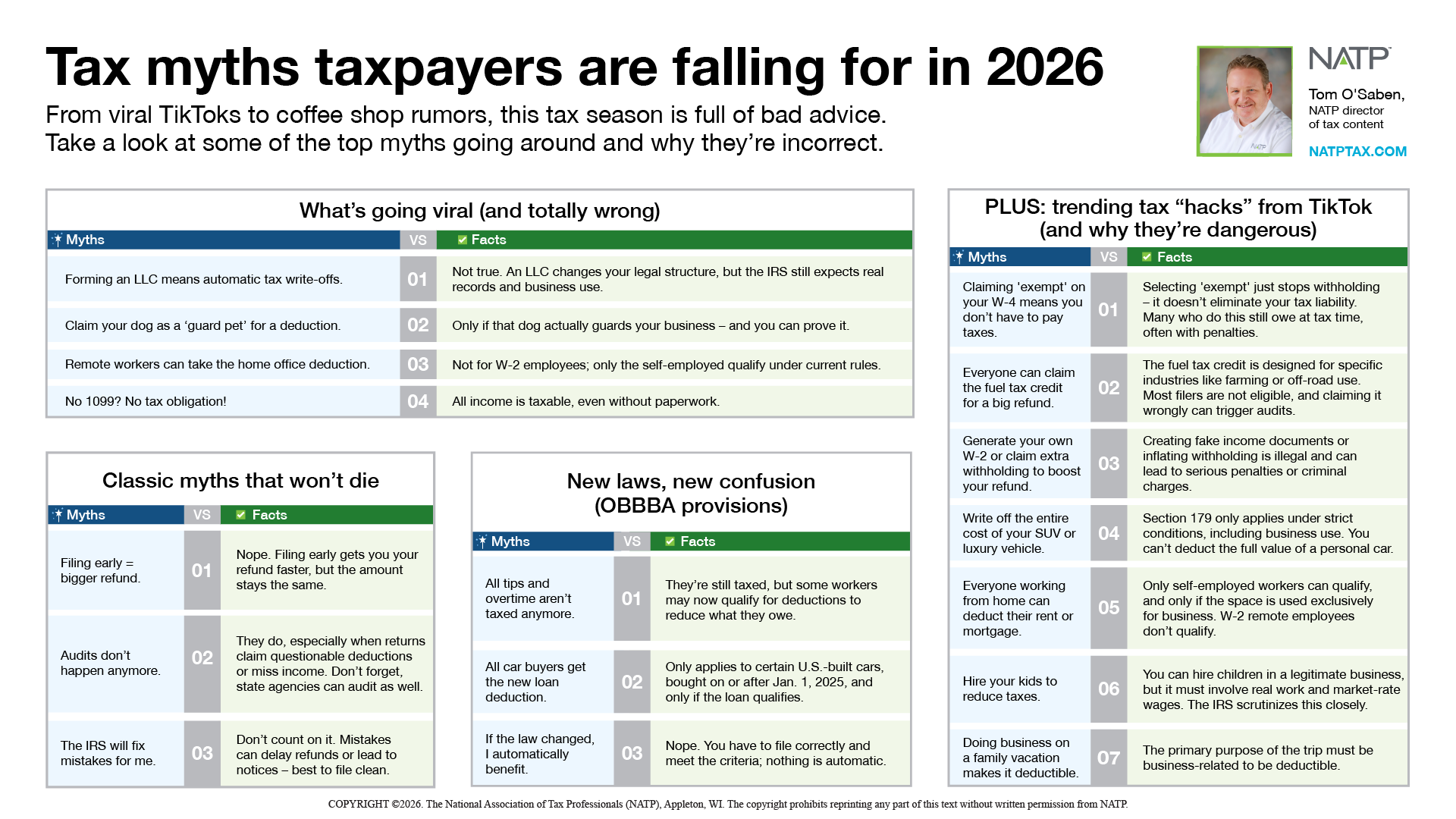
Tax Myths Taxpayers Are Falling For in 2026
Tax Myths Taxpayers Are Falling For in 2026"
Every January, I have the same conversations.
"I heard I can write off my car if I form an LLC."
"Someone told me I don't owe taxes if I didn't get a 1099."
"A video said I can deduct my family vacation if I check email once."
And every year, I have to be the one to say: that's not how it works.
Here's the frustrating part—most of this advice isn't coming from scammers. It's coming from well-meaning friends, viral TikToks, and Instagram "tax gurus" who share half the story and leave out the part that matters: it depends on your situation.
The National Association of Tax Professionals (NATP) just released their 2026 list of the top tax myths taxpayers are falling for. Some are old favorites that refuse to die. Others are brand new misunderstandings about recent tax law changes.
I see these myths in consults, in questions from prospects, and—unfortunately—on tax returns that come to me for cleanup. So let's talk through the ones I'm hearing most often right now.
"If I form an LLC, I get automatic tax write-offs."
I hear this one at least once a week.
Here's what happened: someone saw a video or read a post that said forming an LLC unlocks deductions. And technically, yes—running a business opens up deductions. But the LLC itself doesn't create them.
The Reality: An LLC changes your legal structure. It doesn't change what the IRS considers a legitimate business expense. You still need real records, real business use, and real compliance. Filing paperwork with the state doesn't mean you can suddenly write off everything.
"I can claim my dog as a 'guard pet' for a deduction."
This one makes me laugh every time—until I see someone actually try it.
The Reality: If your dog actually guards your business and you can prove it, maybe. But your golden retriever who naps on the couch and barks at the mailman? Not a business expense.
The IRS wants documentation. Proof of business use. A reasonable connection to income-generating activity. A TikTok telling you it's a "hack" isn't going to hold up.
"Remote workers can take the home office deduction."
I had this conversation twice last week.
A business owner asked if their W-2 employee working from home could claim the home office deduction. The answer? No.
The Reality: Only self-employed individuals qualify for the home office deduction under current rules. If you're a W-2 employee working remotely, the deduction isn't available—even if your employer doesn't provide office space.
"No 1099? No tax obligation."
This is one of the most dangerous myths out there.
I've had clients come in thinking that if they didn't receive a 1099, they don't have to report the income. That's not how taxes work.
The Reality: All income is taxable, whether or not you get a form. The IRS doesn't need paperwork to expect you to report what you earned. And if you don't? That's how audits happen.
"Everyone can claim the fuel tax credit for a big refund."
This one's been trending lately, and it's trouble.
The fuel tax credit sounds great—who doesn't want a big refund? But most people don't qualify.
The Reality: The fuel tax credit is designed for specific industries like farming or off-road commercial use. If you're not using fuel in one of those ways, you're not eligible. Claiming it anyway? That's a fast track to an audit.
"I can write off my entire SUV or luxury vehicle."
Another one I hear constantly: "I bought an SUV for my business, so I can write off the whole thing, right?"
Not quite.
The Reality: Section 179 allows you to deduct the cost of certain business vehicles—but only under strict conditions. The vehicle has to be used primarily (more than 50%) for business. You need documentation. And personal use? That reduces your deduction.
Buying a luxury SUV and calling it a "business expense" because you drove to a client meeting once doesn't cut it.
"If I do business on a family vacation, it's deductible."
I love this one because it's so appealing. And I get why people want it to be true.
But here's what I tell clients: a 10-minute phone call doesn't turn a week at the beach into a business trip.
The Reality: The primary purpose of the trip has to be business-related to deduct it. If you're attending a conference and tack on a weekend for sightseeing, you can deduct the business portion. But if you're on vacation and happen to check email? That's not a write-off.
Why This Matters
The IRS isn't just warning people to be cautious. It's seeing real consequences.
Taxpayers are filing returns full of unsupported deductions, questionable credits, and strategies they learned from strangers online. And when the IRS catches it—and they do—the taxpayer is responsible.
Not the influencer who posted the video. Not the friend who shared the tip. You.
I've seen it result in audits, penalties, interest, and a whole lot of stress that could've been avoided with one conversation upfront.
What to Do Instead
Here's my advice:
✅ Check the source. If the tip doesn't cite IRS publications, court cases, or come from a licensed professional, treat it with skepticism.
✅ Get personalized guidance. Your tax strategy should be based on YOUR business, YOUR income, YOUR situation—not someone else's viral moment.
✅ Work with someone who's accountable. Enrolled Agents, CPAs, and tax attorneys are bound by ethical standards. We're not giving advice for clicks. We're giving it because it's backed by law.
The Bottom Line
Every tax season, the same myths make the rounds. And every year, they cost people money.
If you've been piecing together your tax strategy from social media, coffee shop conversations, or well-meaning friends, it's time to get a second opinion.
At Simply Balanced Accountants, we help Michigan business owners cut through the noise with year-round tax planning that's legal, strategic, and based on your actual financial situation—not a trending hashtag.