
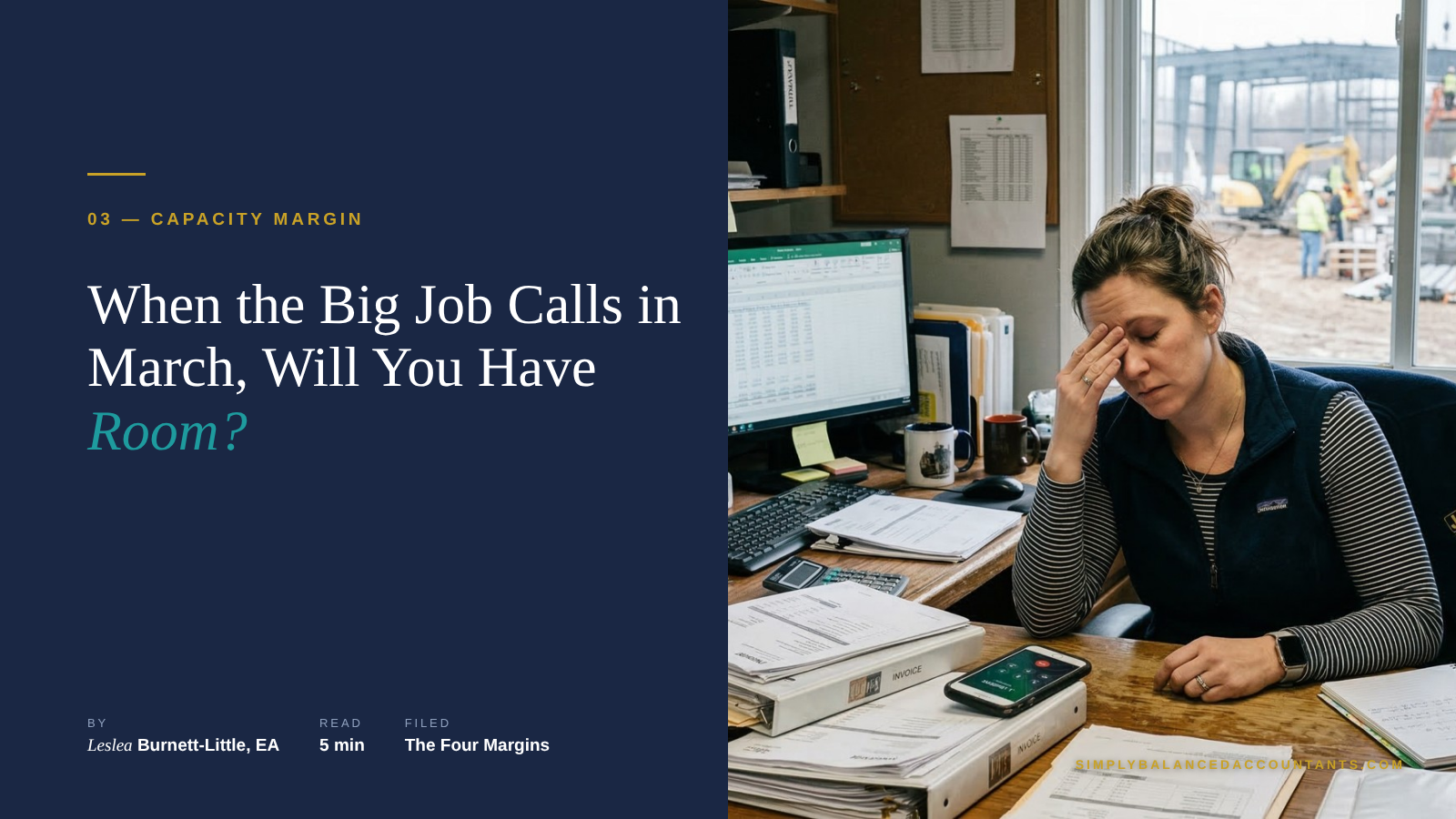
When the Big Job Calls in March, Will You Have Room?
It's the week before Thanksgiving. The schedule is finally loosening up. Two crews are finishing punch lists, one is on a small interior job, and for the first time since April you ate lunch sitting down.
Then the phone rings. It's the builder you've wanted to work with for two years. He has a job starting in March. It's big, it's the right kind of work, and he wants to know if you're in.
Your first thought is, with who?
Your second thought is the truck that needs a transmission. Your third is how you'd float six weeks of payroll before his first draw. By the time you say "let me look at the schedule and call you Monday," the excitement has turned into something closer to dread.
That feeling has a name. It's capacity margin, the third of the four margins, and it's the one that decides whether growth feels like a win or a risk.
Capacity margin is the room to say yes.
Capacity margin is the room to say yes to the right work without breaking what's already running. It lives in four places:
Your crews. Enough people, trained well enough, that a new job doesn't mean pulling your best lead off the one he's on.
Your equipment. Trucks, trailers, and tools that can handle another site without a Saturday spent renting what you're short.
Your cash. Money to carry a job from the first day of labor to the first check. That's the one most owners forget.
You. Room in your week to run one more job without it running you.
When any of those four is full, the answer to the job you want is either no, or yes with a knot in your stomach. It's usually the cash or you that fills up first, because those are the two nobody sees until they're gone.
My calendar was full of the work that called.
I learned this one in my own business, too. For a long time my calendar was full, and I thought full meant healthy. When I looked closer, it was full of the work that called, not the work that counted. Whoever reached me first got the time. The work I actually wanted to build the firm around had to squeeze in around everything else.
So I started choosing on purpose.
What fills your capacity without you choosing it.
In a trades business, capacity rarely fills with the jobs you'd pick. It fills with these:
The repeat customer whose jobs never quite pay, but he's been with you forever, so he gets the next open week.
The small job you squeezed in on a Friday because it was easy money, and it turned into four trips back.
The job you took in a slow week last winter because an empty schedule scared you, at a price you'd never quote in spring.
The work you know how to do in your sleep, so it gets the crew, even though it leaves the least behind. We found that one in the profit post.
None of those were bad decisions in the moment. Together, they're the reason there's no room when the right job calls.
A new crew costs money before it makes money.
This is the part of capacity that catches growing businesses off guard. Say that March job means adding a four-person crew. Loaded, with wages, payroll taxes, and workers' comp, that crew might cost you around $9,000 a week. If the builder pays his first draw six weeks after you start, your business has to carry about $54,000 before a dollar of that job comes back. That's before materials.
A business owner I worked with this summer lived exactly this. Revenue doubled in her second year, and the schedule was booked into November. Then she told me payroll was killing her. Both were true, because she'd put a second crew on before the work that paid for them landed. I wrote about her back in August.
Knowing that number in November is what lets you say yes in March, with the cash already set aside. The winter is when you get ahead of it.
Choose next year's work on purpose.
Here's what I'd do with the slower weeks between now and the new year:
Name the work you want more of. One or two kinds of jobs that pay well, fit your crews, and make you proud to show up. Write them down.
Name the work you'll take less of. Raise the price, shorten the list, or let it go. Every slot you free up is room for the work on the first list.
Put a number on spring. What would one more crew cost to carry from first day to first check? How much cash do you need set aside by March? Is there equipment to buy now, while there's time to plan for it?
Decide your yes in advance. When the March call comes, you want to already know your answer. A quick look at a plan you made in November is the whole job.
That's the difference between growing and growing out of control. Both businesses take on more work. One of them decided where the room would come from before the phone rang.
Next Friday, the day after Thanksgiving, we finish with mental margin, the one all the others land on.
If you're not sure which margin is tightest in your business, or what it says about where you are, take the Stage Assessment. It's free, it takes about three minutes, and it tells you which stage your business is in and what to work on first: simplybalancedaccountants.com/stage-assessment
Read the full Four Margins framework: simplybalancedaccountants.com/news-notes/what-the-year-left-you
To find your stage, go to Start Here
Leslea Burnett-Little, EA, is the founder of Simply Balanced Accountants. She works exclusively with women who own and operate contractor businesses in Michigan — helping them get clear on their numbers, keep more of what they earn, and build a business that works for their family.