
The Second-Best Time to Plan Your Taxes Is Right Now
I love seeing my clients in April. That’s when we see the results of a well-planned year and decide if we want to tweak the plan going forward. There are rarely any surprises and that is the reason we can focus on the what’s next.
That's the best time to plan your taxes. The year is still ahead of you, and every decision is still open.
If you didn't get that meeting in the spring, I have good news. There's a second one, and it's right now.
Twelve weeks is still a lot of year.
Last week I wrote that your taxes aren't a spring problem. Spring is when you see the results. The decisions happen all year, and a lot of it closes on December 31.
Here's what makes October the second-best time. About twelve weeks are left. That's enough time to act, with room to spare.
Wait until December, and that room disappears. The payroll company has a year-end cutoff. The dealer can't promise the trailer will be delivered before the 31st. Your crew is off the week of Christmas. The decisions are still yours on paper, but the calendar has already made half of them.
In October, you still have runway. The move you decide on the 15th can actually happen by the 31st.
What it looks like to have someone look at your year.
This is the job I described last week: a tax partner, someone who works on this year while it's still happening. The simplest way I know to explain it is to show you what I look at when I sit down with a client in October.
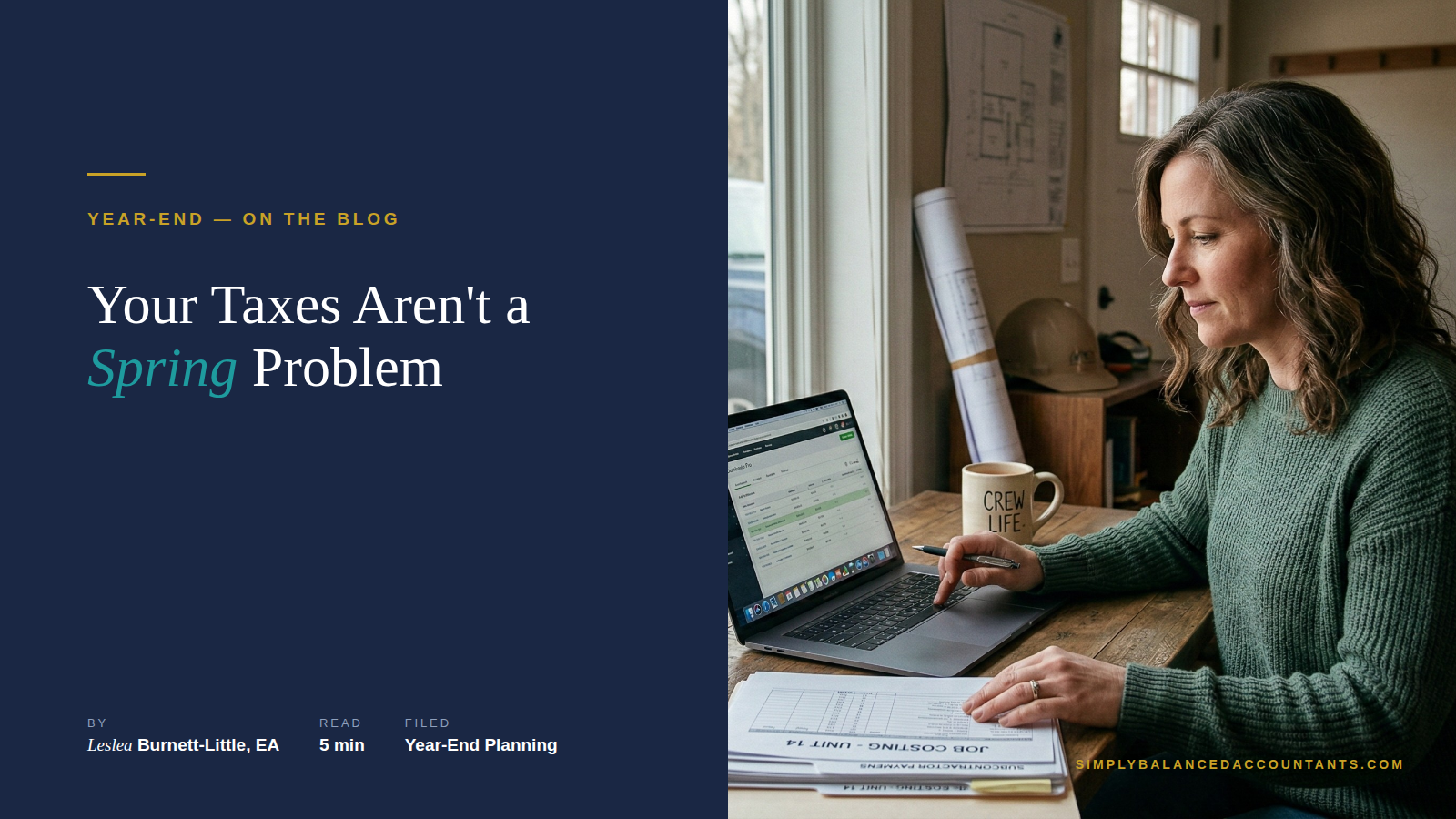
I've already been in her numbers before she walks in. She brings coffee and the list of questions she's been saving since August. Here's what we go through:
Her numbers, right through last month. The bank reconciled, "Ask My Accountant" empty. We aren't doing her bookkeeping. We're making sure the numbers we're about to make decisions on are true.
Where the year is going to land. Her profit so far, plus the jobs still on the board, run out to December 31. This is the number that answers "how is this year going to end?"
Her estimated payments against that number. She wrote the September check. Was it close to the year she's actually having, or the year she guessed back in the spring? I wrote about why the quarterly payment never seems to fit.
Owner pay for the rest of the year. How much she takes and how, including her own retirement contributions. For an owner on payroll, those run through payroll, so they have to be set up before the last payroll of December.
Payroll and contractor 1099s lined up. Every sub she paid this year has a W-9 on file now, while they still answer the phone, and not in the last week of January.
Winter. Pay for the crews through the slow months, and a plan to get the business from December to spring. I wrote about the job summer's money has in the winter.
All of that is about this year, while there's still time to change it.
What she walks out with.
She leaves with a punch list: the items to tackle before she closes the year out, each with a date next to it.
Decide December owner pay before the payroll cutoff. Get the retirement contribution set up with the payroll company this month. Take delivery on the equipment she's already planning to buy before the holidays, or push it to January on purpose. Hold the crew's winter pay in its own account starting in November.
Here's why it takes a meeting and a real conversation. Say her profit through September is running well ahead of what she expected in the spring, and the jobs on the board keep it there. Her September estimate was based on the spring guess. Now she knows, before January 15 instead of after April 15, whether the fourth payment needs to be bigger. Then owner pay and the equipment purchase each move that number again. Those three decisions talk to each other. On a checklist, they look like three separate boxes. Across the table, with her numbers open, they become one plan.
The list is short, and every item on it has a deadline she can actually meet. The equipment question, in particular, is one I walked through in Buying a Truck in December Isn't a Tax Plan.
That's what "ahead of it" feels like. She knows what's coming, and she has a plan for each piece of it.
Second-best still counts.
I want to be clear about something, because I know how October can feel. If you're reading this and your March meeting never happened, everything that matters is still open.
The best time to put a plan in place was March. The second-best time is while twelve weeks are still left, the payroll company still takes changes, and the dealer can still deliver. That's today.
In a few weeks, "second-best" starts to become "whatever's left." The rules stay the same. The calendar fills up: Thanksgiving, the kids' concerts, the last jobs before the ground freezes.
So bring the list. If there's a list of questions sitting in your phone, or a pile in "Ask My Accountant," or a September check you're not sure about, this is the month to bring it to someone whose job is to answer it.
That's the Year-End Walkthrough. We walk through your real numbers together, go through what's still open before December 31, and you leave with a punch list: what to tackle, and by when.
If you want someone to look at your year before it closes, book a Year-End Walkthrough. Let's Talk
Leslea Burnett-Little, EA, is the founder of Simply Balanced Accountants. She works exclusively with women who own and operate contractor businesses in Michigan — helping them get clear on their numbers, keep more of what they earn, and build a business that works for their family.